
OpenCircle
A consent-first app that helps people nearby with shared interests start a conversation.
- My role
- Design solutions: user flows, wireframes, low- to high-fidelity prototypes, icebreaker card game
- Team
- Team project, MSc User Experience Design, University of Portsmouth
- Tools
- Figma, pencil sketches
- Methods
- Interviews, survey, competitor analysis, personas, usability testing, heuristic evaluation
The problem
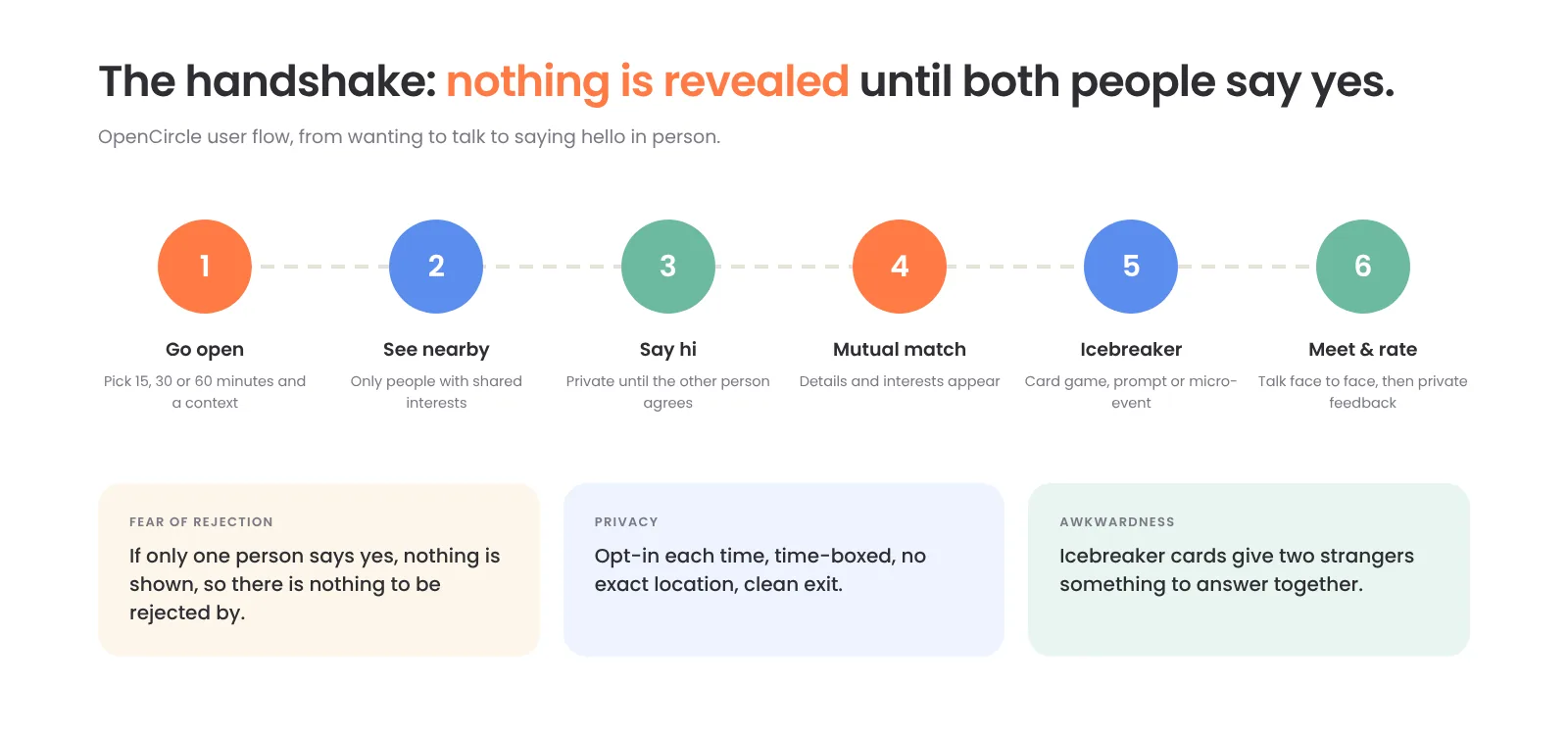
People often want to talk to someone who shares their interests, but hold back. They worry about being intrusive, can’t tell if the other person is open to talking, and fear rejection. “The hardest part is not knowing if they want to be approached,” one interview participant said.
The idea came from lived experience: as an international student in the UK, starting new connections felt hard and forced.
UX challenges
Research with 6 interviews and 32 survey responses showed the same UX problems again and again:
- People struggle to approach strangers, but shared interests motivate them.
- They want to know when others are open to talking.
- Privacy is non-negotiable.
- Playful features help break the ice.
The design question: how might we help people start real-life conversations with nearby people who share their interests, without pressure or privacy worries?
Design process
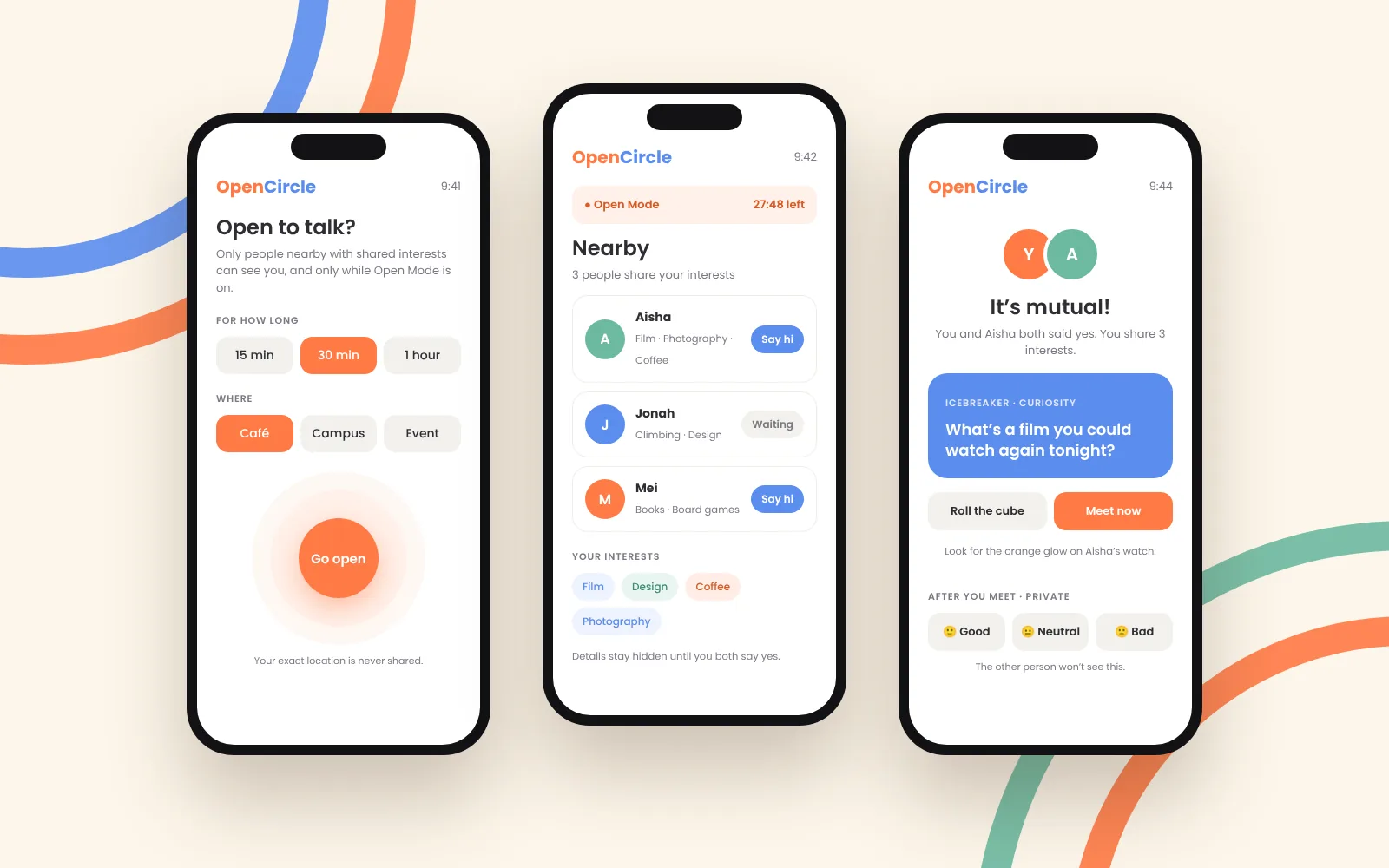
My focus was designing the solution. The first concept was a wearable band that glows when its owner is open to talking, but custom hardware is a barrier. We pivoted to a mobile app, then used a smartwatch as the glow.
I mapped four task flows before drawing any screens: onboarding, Open Mode, discovering people and micro-events. Wireframing the phone and watch apps kept the focus on structure. User flow prototyping in Figma then took the design from low to high fidelity.
The solution
People switch on Open Mode for 15 minutes, 30 minutes or an hour and see nearby people with shared interests. The core rule is a handshake: details appear only when both people say yes, so there is nothing to be rejected by. After a match, an icebreaker card game or prompt gives two strangers something to answer together, and the conversation happens face to face.
Results and learnings
Five moderated usability tests led to an easier way to turn on Open Mode and friendlier wording. Participants said they felt less intrusive and less awkward. A heuristic review against Nielsen’s 10 heuristics checked clarity and emotional safety.
The lesson: making consent the core mechanic, not a policy, made the design both safer and simpler.